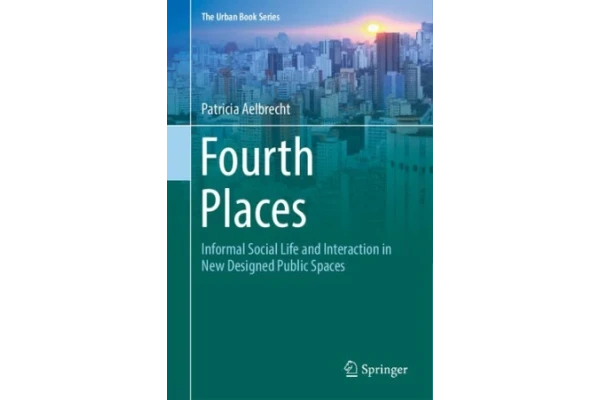
Fourth Places: Informal Social Life and Interaction in New Designed Public Spaces
This book challenges current views that public life is in decline and that contemporary urban design trends reliant on privatisation, control, events, and thematic designs are to be blamed. Drawing on detailed and extensive analysis of a case study that illustrates well such urban design trends, it shows that informal social life and interaction occur more than its necessary in new master planned environments and new designed public settings, whether public or private owned and/or managed. Furthermore, it reveals the existence of a new category of informal public social settings which it calls fourth places because of their close relationship to Oldenburg’s third places in terms of social and behavioural characteristics – radical departure from the routines of home and work, inclusivity and social comfort – but distinct in terms of activities, locations and spatial conditions – being characterised by spatial, temporal and managerial in-betweenness, i.e. indeterminacy in form, function and times, and a great sense of publicness.
The acceptance of these findings problematises well-established urban design theories about master planning, expands existing social theories about the optimal conditions for public social life by empirically and spatially elaborating on them and redefines several spatial concepts for designing public space in relation to the specific dynamics of informal social interaction. More importantly, it brings optimism to urban design practice, offering new insights into designing more lively and inclusive public spaces.
Year:2022
Publisher:Springer
Language:English
Pages:253
ISBN 10:3031079450
ISBN 13:9783031079450
Series:The Urban Book Series
File:PDF, 7.92 MB
IPFS:CID , CID Blake2b





دیدگاه خود را ثبت کنید